

Luminar Legacy Campaign Has Started: Desktop Plan for €59
Special pricing for eligible owners of previous Skylum products.
We’re excited to let you know that the Luminar Legacy Campaign starts today, September 21!
Owners of previous Skylum products — including Luminar AI, Luminar 4, Luminar 3, Luminar 2018, Aurora HDR, and other eligible legacy products — may be eligible to upgrade to Luminar at the special €59 Desktop Only price instead of €129.
Please note: The special €59 Legacy offer is available to eligible users once they log in to their Skylum account. New users will see the standard offer instead.
📅 Campaign timeline: September 21, 15:00 (EEST) – October 16, 2026
Get the Luminar Legacy Offer →Disclosure: We may earn a commission from purchases made through our affiliate link. This does not affect the price you pay.
If you’ve been searching for private search engines that actually walk the talk, you’re in the right place. We spent weeks testing the leading search engines that don’t track you, comparing their result quality, their privacy policies, and how they actually behave under the hood — not just what their marketing pages promise.
Every time you type a query into a search engine, you’re sharing information that can be collected and used in different ways. With Google, search activity can be associated with your account and used alongside other information to personalize your experience and advertising. That’s one reason some people are looking for alternatives that put more emphasis on privacy.
This guide breaks down the best privacy search engines in 2026, how they stack up against each other, and which one might be the right fit depending on what you actually need: Google-quality results, greater independence from Big Tech, or the simplest possible setup.
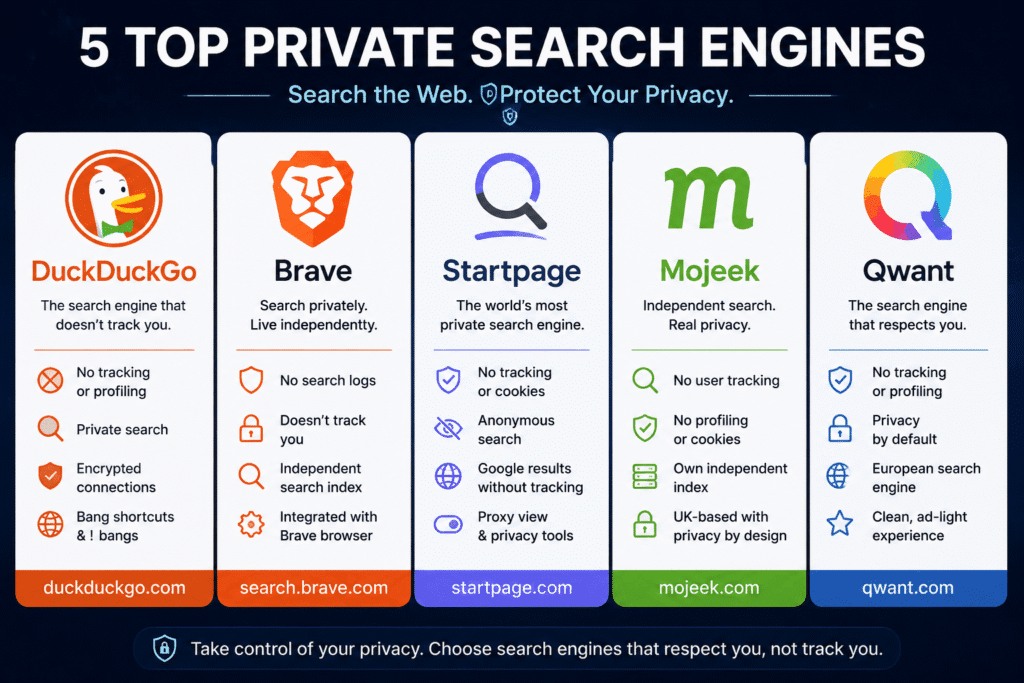
Table of Contents
- How We Tested These Private Search Engines
- Quick Comparison Table
- 1. DuckDuckGo — Best All-Around Private Search Engine
- 2. Brave Search — Best Independent Index
- 3. Startpage — Best for Google-Quality Results
- 4. Mojeek — Best Fully Independent, No-Compromise Index
- 5. Qwant — Best EU-Based Privacy Option
- Are Alternative Search Engines Actually Safer Than Google?
- How to Search the Web Without Being Tracked
- FAQ: Your Private Search Questions Answered
How We Tested These Private Search Engines
Before ranking anything, we wanted to go beyond the “no ads, much privacy” marketing copy every search engine puts on its homepage. Our testing methodology looked at four things:
- Search engine index — does the engine crawl and rank the web itself, or does it act as a meta search engine pulling from Google or Bing?
- Data logging policy — does the provider log your IP address, query history, or device fingerprint, even temporarily?
- Ad model and targeted advertisements — are ads matched to the current query, or to a stored profile built from your user tracking cookies and past behavior?
- Real-world result quality — We ran the same 25 queries (local searches, technical questions, shopping comparisons, and news) across every engine and compared relevance side by side.
We also read each provider’s published privacy policy line by line, since browser telemetry and backend data handling rarely show up in a homepage pitch. A search engine can claim “we don’t track you” while still allowing third-party scripts, ad partners, or meta search engine dependencies to quietly collect data downstream. That distinction matters more than most reviews let on, and it’s a big part of why some engines placed higher than their marketing budgets might suggest.
Quick Comparison Table
| Search Engine | Own Index? | Tracks IP/Search History? | Best For |
|---|---|---|---|
| DuckDuckGo | Partial (Bing-assisted) | No | Simplicity + extra privacy tools |
| Brave Search | Yes (independent) | No | Breaking away from Big Tech entirely |
| Startpage | No (Google proxy) | No | Google-quality results, privately |
| Mojeek | Yes (fully independent) | No | Zero third-party dependency |
| Qwant | Partial (hybrid) | No | EU-based, GDPR-first users |
1. DuckDuckGo — Best All-Around Private Search Engine
DuckDuckGo is usually the first name people think of when they search for an anonymous search engine, and for good reason — its privacy policy states plainly that it doesn’t save or share your search history and has no way to tie your searches or site visits back to you personally.
What stood out in testing:
- Fast, familiar interface that’s an easy switch for ex-Google users
- Strong tracker-blocking layer through its browser and extensions, including cookie protection, link-tracking protection, and CNAME cloaking protection
- Its Duck.ai chat feature adds anonymous access to AI models without linking prompts to your identity
- Ad revenue comes from contextual, non-profile-based search ads rather than behavioral targeting
Where it falls short:
- DuckDuckGo still leans on Bing’s infrastructure for a portion of its results, so it isn’t a fully independent index
- In 2022, researchers found Microsoft-related trackers were allowed to bypass some of DuckDuckGo’s blocking — an issue the company has since fixed, but one that’s worth knowing about
- Once you click through to an external site, that site’s own trackers and cookies apply; DuckDuckGo’s protection stops at its own front door
Is DuckDuckGo Actually Private?
Short answer: yes, for the vast majority of everyday use. DuckDuckGo’s core search product genuinely doesn’t build user profiles or store identifiable search logs. The nuance is that “private” isn’t the same as “invisible” — your ISP can still see that you’re using duckduckgo.com, and any optional feature you opt into (like Email Protection) will need some data to function. For casual to serious privacy needs, it clears the bar. For situations demanding total anonymity, pairing it with Tor or a reputable VPN is the recommended move.
2. Brave Search — Best Independent Index
If your priority is escaping Google and Bing’s infrastructure entirely, Brave Search is the strongest option on this list. It runs on its own crawler-built index — originally developed from the Tailcat project — rather than repackaging someone else’s results.
What stood out in testing:
- A visible “independence score” on every results page shows exactly what percentage of results came from Brave’s own index versus supplementary sources — a transparency feature no other engine on this list offers
- Goggles let you apply community-built filters to re-rank results without relying on Brave’s default algorithm
- No profiling, no stored search history, and no third-party data sharing for ads
- Solid relevance for mainstream, English-language queries
Where it falls short:
- Historically weaker on niche, technical, or non-English long-tail queries compared to Google or Startpage, though Brave says its Web Discovery Project has closed much of that gap
- The optional Google fallback-mixing feature, while anonymous, means some queries can still indirectly touch Google’s index if you enable it
Brave Search Privacy Review
Brave’s privacy model is genuinely different from most engines on this list: it doesn’t just avoid selling your data — it structurally can’t, because it isn’t collecting a profile to sell in the first place. Combined with the Brave browser, this makes for one of the more complete privacy-by-design setups available for free.
3. Startpage — Best for Google-Quality Results
Startpage takes a different approach entirely: instead of building its own index, it acts as a privacy proxy in front of Google. It strips identifying information from your query, submits it to Google on your behalf, and returns the results without passing along anything that could tie the search back to you.
What stood out in testing:
- Genuinely Google-quality results, including local search and complex queries where independent-index engines sometimes struggle
- Anonymous View — a built-in proxy that lets you open a result through Startpage’s own servers, so the destination site sees Startpage’s IP instead of yours
- Based in the Netherlands, so it operates under GDPR, giving it a legal privacy backstop beyond just its own policy
Where it falls short:
- Startpage is owned by System1, a US advertising technology company, which has raised legitimate concerns in the privacy community about long-term incentives even though Startpage’s technical no-log model hasn’t changed
- Anonymous View pages load more slowly, and some JavaScript-heavy sites don’t render correctly through the proxy
Startpage vs Brave Search
If your top priority is anonymous Google results — meaning you want the search quality you’re used to without Google seeing who’s asking — Startpage is the better pick. If your priority is avoiding Google’s infrastructure altogether, Brave wins. Both share the same “no tracking” foundation; they simply solve for different definitions of privacy.
4. Mojeek — Best Fully Independent, No-Compromise Index
Mojeek is a UK-based search engine that’s built its own crawler and index completely from scratch, making it one of the very few engines in the world that has zero dependency on Google, Bing, or any other third-party provider.
What stood out in testing:
- Total independence — Mojeek doesn’t outsource a single piece of its result pipeline
- No tracking cookies, no IP logging, no personalized results based on past behavior
- A “Focus” dashboard lets you build custom filters for specialized or recurring research
- Eco-friendly infrastructure, with servers hosted at renewable-energy-powered data centers
Where it falls short:
- Because its index is smaller than Google’s or Bing’s, results depth for niche, very recent, or highly specific queries can lag behind the bigger names on this list
- No AI-generated summaries or overviews, which some users may miss
Mojeek Independent Index Review
Mojeek is the closest thing to a “raw,” unfiltered view of the web among mainstream private search options. For everyday browsing it holds up fine; for deep research or obscure technical queries, you may find yourself occasionally falling back to Brave or Startpage. If ideological independence from Big Tech infrastructure is non-negotiable for you, Mojeek is unmatched.
5. Qwant — Best EU-Based Privacy Option
Qwant is a French search engine built specifically around GDPR compliance, making it a natural pick for European users who want a search engine that’s legally, not just voluntarily, bound to strict privacy standards.
What stood out in testing:
- Doesn’t use tracking cookies at all — your activity effectively disappears the moment you leave the site
- Non-personalized, contextual ads rather than behaviorally targeted ones
- Results are organized into clear categories (news, social, images), which makes scanning faster
- Qwant Junior offers a filtered, family-safe search experience
Where it falls short:
- Qwant blends its own indexing with Bing-sourced results for full coverage, so it isn’t a fully independent index the way Brave or Mojeek are
- Some data still flows through Microsoft for parts of the search and ad pipeline, which slightly complicates its “fully sovereign” positioning
Qwant vs DuckDuckGo
Both engines lean on outside infrastructure for part of their results, but Qwant’s EU jurisdiction and GDPR obligations give it a legal privacy backstop that DuckDuckGo, as a US company, doesn’t have in the same way. If jurisdiction matters to you as much as policy, Qwant is the more defensible choice; if you want the broader ecosystem of privacy tools (browser, email protection, VPN), DuckDuckGo remains ahead.
Are Alternative Search Engines Actually Safer Than Google?
Generally, yes — but “safer” and “private” aren’t quite the same thing. Every engine on this list avoids building the kind of long-term behavioral profile that funds Google’s advertising business. None of them log your search history and tie it to your identity by default.
That said, “private” doesn’t automatically mean “secure.” Google’s scale gives it some advantages in phishing detection and account protection that smaller, privacy-first engines simply don’t have the resources to match. The trade-off is straightforward: you’re exchanging some of that infrastructure muscle for the reassurance that your searches aren’t quietly building a profile that follows you around the internet in the form of targeted advertisements.
If you’re rebuilding your privacy setup from the ground up, pairing a private search engine with a reputable browser and a password manager rounds things out — we cover the broader toolkit in our guide to beginner-friendly digital privacy tools.
How to Search the Web Without Being Tracked
Switching your default search engine is the single highest-impact change you can make, and it takes under a minute:
- On Chrome: Settings → Search engine → choose your preferred option
- On Firefox: Settings → Search → Default Search Engine
- On Safari: Preferences → Search
- On Brave: Brave Search is the default out of the box
Beyond the switch itself, a few habits meaningfully reduce your exposure:
- Use a browser with built-in tracker blocking (several of the engines above ship one)
- Avoid staying signed into a Google or Microsoft account while searching, since account-linked searches are far easier to profile
- Consider a VPN if you also want to hide your searches from your ISP — a private search engine stops the search provider from tracking you, but your internet provider can still see which sites you visit unless your connection itself is encrypted end-to-end
- Periodically check what your current browser is sending in the background; browser telemetry settings are usually buried in advanced preferences and often opted in by default
FAQ: Your Private Search Questions Answered
What search engine does not track search history?
DuckDuckGo, Brave Search, Startpage, Mojeek, and Qwant all state clearly in their privacy policies that they do not store search history tied to an individual user. DuckDuckGo and Brave Search are the two most tested and widely adopted options for this specifically.
How do I search the web without being tracked?
Switch your default search engine to a privacy-focused option like DuckDuckGo or Brave Search, avoid staying signed into a Google or Microsoft account while searching, and pair your browser with tracker-blocking extensions. For full anonymity, combine this with a VPN or the Tor browser.
Which private search engine has its own index?
Brave Search and Mojeek both operate fully independent, self-built indexes with no reliance on Google or Bing. Startpage and Qwant, by contrast, rely partly or fully on Google or Bing’s index while stripping identifying data before the query is sent.
What’s the best search engine for privacy and ad blocking?
Brave Search paired with the Brave browser is the strongest combination for this, since both the search engine and the browser are built around blocking trackers and ads by default without needing extra extensions.
Are alternative search engines safer than Google?
They’re more private by design — none of them build long-term behavioral profiles the way Google’s ad business depends on. Whether they’re “safer” in a broader security sense depends on your threat model, since Google’s scale gives it stronger built-in phishing and account-security tooling.
If you’re just getting started with cleaning up your digital footprint, private search is one of the easiest first wins. For more beginner-friendly breakdowns like this one, check out our other product reviews and privacy guides on the blog.
Warm regards,








Please keep comments helpful and respectful.
No affiliate links, promotional links, or YouTube URLs.
Let’s keep our community clean and supportive! 💙